
BOHEMIAN VENEERS
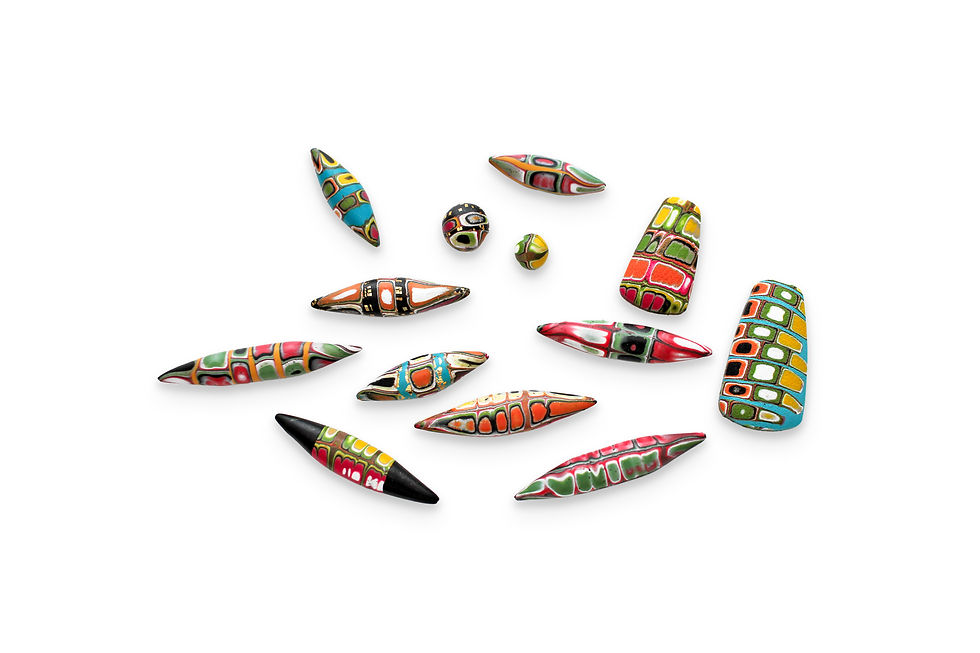
Inspired by the beauty of seed pods and the warm hues of nature, this tutorial by Susana Paredes will guide you through creating organic-looking veneers that can eventually be transformed into beautiful bohemian pendants. Ready to dive in?

1.
Let’s begin by creating a lovely color palette by mixing the polymer clay in the following ratios:
Earthy Red: 1 part orange, 3 parts true magenta Moss Green: 2 parts leaf green, 1 part orange, 1 part translucent green, 1 part true yellow Warm Yellow: 3 parts true yellow, 1 part orange Deep Orange: 3 parts orange, 1 part true magenta, 1 part true yellow

2.
Mix each color thoroughly until you achieve this warm, earthy palette.


4.
Blend it well until you achieve the look shown in the picture.

5.
Create strips using the four colors and slightly overlap them with stripes of the botanical clay to create gradient sheets.

6.
Run each sheet through the pasta machine several times, folding it repeatedly to create a thin, smooth gradient strip.

7.
Cut 3 round shapes from each colored sheet at the thickest setting (#0). Also cut 5 black circles, 5 white circles, and 10 translucent circles with gold leaf at setting #4.

8.
Stack the circles in this order: first the green and orange together, connecting the colored side of the green with the botanical side of the orange. Then add black and translucent, followed by red, white, and translucent, then yellow, black, and translucent, then green, white, and translucent. Repeat the sequence, beginning again with the red, until all the circles have been stacked.
Each time you add a colored piece, alternate the colored side so it always connects with the botanical side of the previous piece, as shown in the picture.

9.
Place the stack inside the clay extruder with the green and orange section at the top. Close the extruder using disc #12.

10.
Carefully extrude the entire clay stack.

11.
Cut the extruded clay into 4 cm pieces and arrange them in order: place the first cut at the top, the second below it, and continue until your piece looks like the one shown in the picture.

12.
Run the piece through the pasta machine at setting #2. Place it firmly onto a tile, then add a piece of scrap clay at the bottom edge to make the process easier and prevent the veneer from breaking or smearing.

13.
Using a wavy blade, carefully peel thin strips of clay from the surface — not too thick and not too thin. Slightly bend the blade so you can remove about three strips at a time.

14.
Finish peeling the first section and set the strips aside.

15.
Then continue peeling the untouched areas of the sheet in the same way.

16.
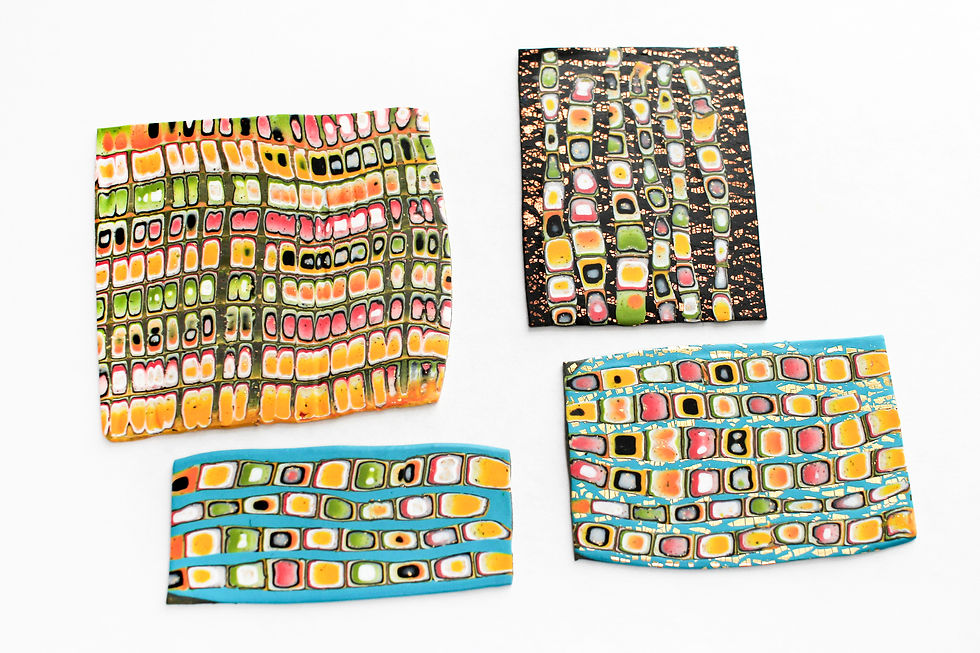
When finished, you will have a veneer like the one shown in the picture. Set all the strips aside and discard the scrap clay.

17.
Prepare background sheets of clay at setting #4. For this piece, I used one plain turquoise sheet, one turquoise sheet with gold leaf, and one black sheet with copper leaf. Arrange your colorful clay shavings over the surface, as shown in the picture.
18.
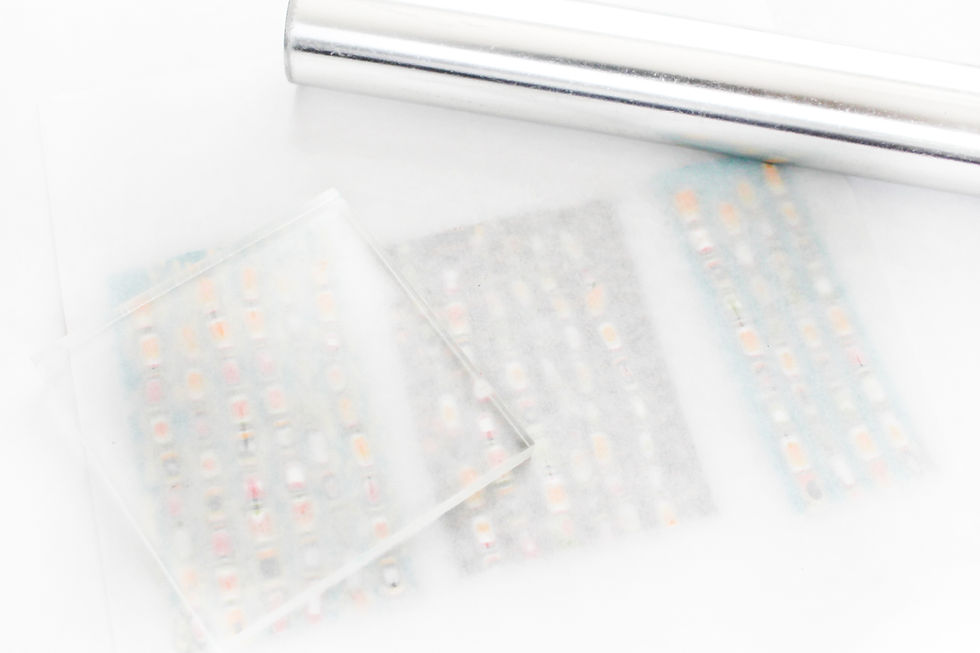
Place parchment paper over the sheets and burnish them by first pressing with an acrylic block and then rolling with a roller until the surface is as flat as possible.
19.
Pass the sheets through the pasta machine at setting #3, taking care not to distort the pattern too much. Do the same with the original veneer.
Want to see how these veneers become beautiful bohemian pendants? Discover the full tutorial, including the wirework techniques, on the Polymer Week Society platform, connecting hundreds of polymer clay artists worldwide.


Comments